
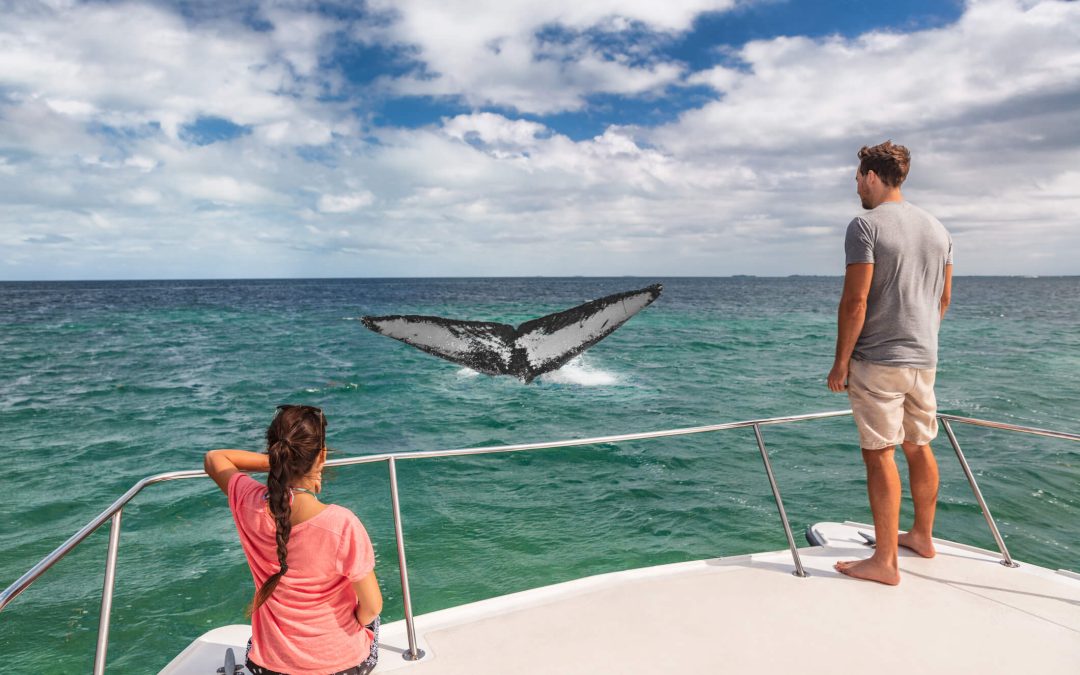
Ask people to picture a whale watching trip, and many of them describe a humpback: a huge animal leaving the water, a slap of a long white fin, a tail rising before a deep dive. Humpbacks are the showmen of the whales, and off Dana Point they are also one of the most commonly seen.
The question that matters on a humpback trip is less about the calendar and more about the water. Where humpbacks show up, and what they are doing when they get there, comes down to food. This guide covers the short season window, then focuses on where to look and how to read what you see.
When Humpbacks Are Here
Humpbacks are generally seen off Southern California from late April through early December, with the strongest stretch running from roughly May into November. That puts them in the water alongside blue whales through the summer and still active in the fall, well after most visitors assume the season is over. For the full year at a glance, including gray whale season in winter, see our guide to the best time for whale watching in Dana Point.
Where to Look: Follow the Food
Humpbacks are feeders, and they go where the prey is. According to NOAA Fisheries, humpbacks can often be found close to shore and tend to show off near the surface, which is a big reason they are a whale watcher favorite. Compared with blue whales, which feed on krill and often feed farther offshore, humpbacks are frequently found closer to shore, which is good news when choosing a trip length. Our guide to blue whale season in Dana Point covers why those animals call for a longer trip.
On the water, the best clues point to the food itself, not the whale:
- Working birds: a tight flock diving on one patch of water often means baitfish below, and baitfish attract everything else.
- Dolphins: large groups of dolphins feeding in one area are another sign that fish are concentrated there.
- A boiling or darkened surface: schooling fish pushed upward can change how the water looks long before a whale appears.
In fall, when baitfish like anchovies and sardines ball up near the surface, humpbacks can feed close enough to the boat that the whole scene fits in one view. A private trip works well for this because the captain can stay with a feeding area instead of following a fixed route.
Reading Humpback Behavior
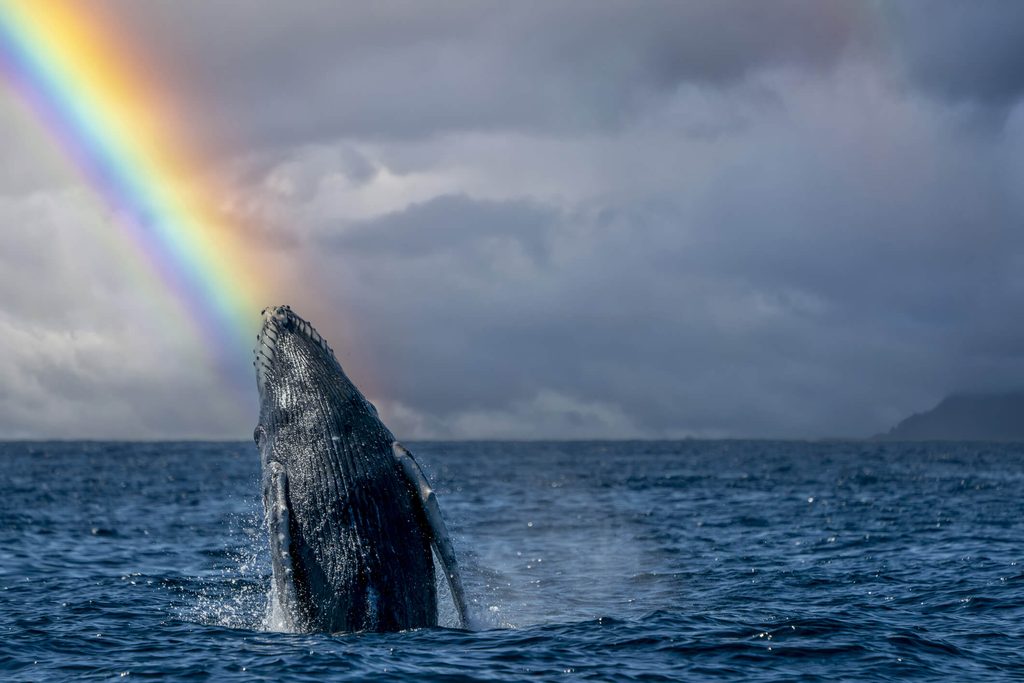
Humpbacks are surface-active, which means a lot of what you see has a name. Knowing the vocabulary makes a sighting more rewarding because you start to understand what the animal is doing, not just that it is there.
- Breach: the whale launches much of its body out of the water and lands with a crash. It is the signature humpback move.
- Pectoral slap: the whale slaps the surface with a pectoral fin. Humpbacks have the longest fins of any whale, roughly a third of their body length, so this one is hard to miss.
- Tail slap: the whale lifts its tail and brings it down on the surface, sometimes repeatedly.
- Lunge feeding: the whale rushes upward with its mouth open to gulp prey and water, sometimes with its head coming almost straight out of the surface.
- Spy hop: the whale rises vertically until its eye is above the water, as if taking a look around.
- Fluke-up dive: the tail rises as the whale starts a deeper dive. That usually means it will be down for a while, so use the pause to scan the surrounding water.
Why do humpbacks breach and slap? Honestly, researchers have not settled it. Leading ideas include communication, removing parasites, and simple play, and it may be some mix of those depending on the moment. That open question is part of the appeal.
How Humpbacks Differ From the Whales You Might Also See
Humpbacks reach about 60 feet and have a distinctive hump, knobby head, and long pectoral fins. Gray whales, by contrast, are low-profile coastal migrants that travel in winter, and blue whales are far larger and much quieter at the surface. If you are curious about winter sightings, our gray whale migration guide explains the timeline. For a humpback trip, you are looking for energy: spouts, splashes, and fins at the surface instead of long, steady rolls.
Getting the Most Out of a Humpback Encounter
Humpbacks are unpredictable, so the best preparation is a ready eye. Keep your camera on burst mode, but do not spend the whole sighting looking through a screen. A breach can happen in a second, and you will want to see it with your own eyes. When a whale is near, the captain will slow the boat and keep a respectful distance; our guide on what to expect on a private whale tour explains how encounters work and why the whales set the pace.
Ready to Look for Humpbacks?
Humpback season gives you months of chances, and a private trip lets you spend them following the action instead of a schedule. If you are exploring private whale watching tours in Dana Point, Pacific Whale Tours Dana Point can help you choose the trip length that fits what you want to see. Reach out to the captain to talk through your dates and your group.
Frequently Asked Questions
When is humpback whale season in Dana Point?
Humpbacks are generally seen from late April through early December, with the best stretch running from about May into November.
Where are humpback whales found off Dana Point?
Humpbacks follow their food, so they can turn up wherever baitfish are concentrated. They are often found closer to shore than blue whales, and flocks of birds and feeding dolphins can point toward the right area.
Why do humpback whales breach?
No one knows for certain. Theories include communication, shaking off parasites, and play, and the reason may vary from one breach to the next.
Can you see humpbacks on a short tour?
Often, yes. Humpbacks are commonly found nearer the coast than blue whales, so a standard trip can work well. No trip can guarantee a specific animal, but humpback season gives you many opportunities.
What is the difference between a humpback and a blue whale?
Humpbacks are smaller, more surface-active, and known for breaching and fin slaps. Blue whales are much larger and quieter at the surface, and they often feed farther offshore.